When the Bell Speaks Louder Than the Lesson: Building a Sensory-Safe Fire Drill Plan With Your Child's School
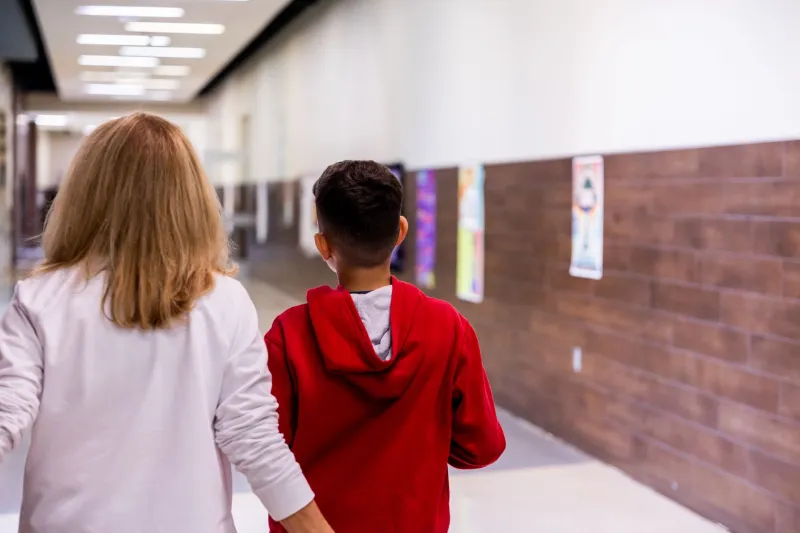
Fire drills occupy an odd place in school life. They are one of the few events that arrive without warning, override every other instruction in the building, and require every person present to do the same thing at the same moment. For most pupils this is a brief interruption. For some autistic children it is the single most distressing fifteen minutes of the week — and, crucially, one of the least planned for.
This article is not a case for exempting anyone. Fire safety is a life skill, and an autistic young person needs to know what to do when an alarm sounds just as much as anyone else. The argument here is narrower and, we think, more useful: that the how of preparation is almost entirely within a school's control, and that a short written plan agreed between family and school can transform the experience without touching the drill's integrity.
Why the alarm lands differently
A commercial fire alarm is designed to be unignorable. Many sit around 85 to 95 decibels at close range, with some sounding considerably higher in corridors and halls. For a child with auditory sensitivity, the sound is not merely loud; it can be physically painful and briefly disorientating, arriving with no lead-in and no clear end point.
Add the rest of the picture: several hundred people moving at once, doors held open, the sudden loss of the timetable, the cold of the playground in November, the uncertainty about whether this is a practice or the real thing, and the reasonable fear of not being able to retrieve a coat, bag or ear defenders. None of this is naughtiness. It is a nervous system doing exactly what nervous systems do when the environment changes without notice.
Keep safety at the centre
Before anything else, agree a shared principle with the school: the plan exists to help the child participate fully in the evacuation, not to excuse them from it. Schools in the UK carry out drills regularly — commonly at least once a term — and staff have legal duties around fire safety that no individual plan can override. A good plan makes the child faster, calmer and more competent in a real emergency. It never leaves them out of the count.
That framing also helps at home. It gives the conversation a practical shape, and it reassures a headteacher that you are not asking for an exception.
The one-page plan
The most effective versions of this work we hear about fit on a single side of A4, filed with the pupil's passport or individual support record and copied to every adult who might be on duty. It usually has four sections: before, during, after, and review.
Before: notice, not surprise
This is the part schools are often most anxious about, on the grounds that drills must be realistic. In practice, notice and realism coexist comfortably. A named adult can tell the child at the start of the day that there will be a practice at some point that morning, without fixing the exact minute. That single sentence removes the ambush while preserving the need to respond when the alarm actually sounds.
The school can also choose when the practice happens. Site managers and fire marshals generally have discretion over timing, and it costs nothing to avoid scheduling a drill during a known difficulty — the crush of a corridor changeover, a PE changing room, a lunch hall, or a sensory-heavy assembly.
The supports that travel with the child
Ask for ear defenders to be kept at the desk, labelled, rather than in a bag in a cloakroom. A spare pair in the school office and a third in the PE changing area removes the most common failure point. Some families also ask for a laminated card showing photographs of the actual route and the actual assembly point, plus a short social story using real images of the real doorways — not generic illustrations.
A small, agreed script helps too. Staff saying "This is a practice. You are safe. Walk with me to the top field" is more useful than a general instruction shouted over an alarm.
During: the exit route and the named adult
Schools must use the nearest available exit, and that requirement should stand. Within it, though, there is room to move. Many settings agree that the child leaves with a designated adult a few seconds after the main surge, at the back of the line rather than in the middle of it — arriving at the assembly point a moment later but far steadier. Others identify a specific exit where the site layout genuinely allows it, subject to the fire officer's agreement.
Name one lead adult and one backup, in writing. Absence cover is where these plans most often fall apart. Clarify what happens if the child is in the toilet, in the medical room or off-site on a trip when the alarm sounds.
After: recovery is part of the plan
A drill is not over when the register is taken. Agree a quiet space, a drink, and ten or fifteen minutes without academic demand before the child returns to class — and agree that this is not a reward for distress but a routine part of the procedure, applied whether or not the child appears upset at the time.
Ask for a short debrief with a familiar adult, the same day or the next morning: what worked, what was hard, what should change. Keep it conversational and keep it separate from any behavioural consequence. A child who ran, covered their ears or cried has given useful information, not committed an offence.
For families: how to ask
Put the request in writing to the SENCo, copying the form tutor and, where relevant, the head of year. Keep it brief and practical: describe the difficulty, propose the specific adjustments, and offer to review after the next drill. If your child has an EHCP, ask for the agreed plan to be named in the provision; if not, ask for it to sit in the pupil passport or support profile. The language of reasonable adjustments under the Equality Act 2010 is helpful here, used calmly rather than as a threat.
Review it each term
A plan agreed in September will be out of date by February — new rooms, new staff, new corridors, a child who has grown. Build the review in from the start, and revisit it after any real evacuation as well as after each practice. Small refinements, made early and in writing, tend to prevent the larger breakdowns later.
The aim throughout is modest and important: that a child should be able to say, afterwards, I knew what was happening and I knew what to do. Everything else is detail.